
Inside Dooly County Tax Records
Two offices divide the work in Dooly County. The Board of Tax Assessors keeps the parcel data through its qPublic material, including digest values, legal-description clues, exemptions, and assessment history where available. The Tax Commissioner handles the bill, payment record, delinquency status, and receipt. One caution: a value shown on the parcel layer is not the amount due. A paid bill is not proof of title either. Read each field in the record that created it.
| Field | What It Shows | Where |
|---|---|---|
| Assessed value | The taxable value carried on the assessment record | Board of Tax Assessors / qPublic |
| Value components | Raw CAMA and ArcGIS fields that require local definitions | Assessor or parcel-layer export |
| Exemptions | Homestead and other relief coded to the parcel | Assessor and Tax Commissioner |
| Bill and status | Tax year, charge, payment, balance, penalties, or receipt | Tax Commissioner |
| Sale or execution trail | Separate notices, executions, orders, and recorded deeds | Tax Commissioner, Clerk, court, legal organ |
Dooly's exemption guidance takes the standard homestead deduction from the 40 percent assessed value. That rule does not make every ArcGIS field a verified market figure. The regional layer carries names like curr_val, a_value, fmvres, and sale_val. But the county publishes no field dictionary for them. Ask the assessor what a field means before using it in a tax estimate. Recorded consideration on a deed or PT-61 is also distinct from a CAMA sales field.
Dooly Assessor and Collector Roles
The Dooly qPublic landing page gives the division of labor plainly. The Board of Tax Assessors establishes property values. Bill questions go to the Tax Commissioner. The assessor's office sits at 105 W. Cotton Street, Room 2, in Vienna. Staff there can explain appraisal data, parcel identity, legal-description text, or exemption coding. Posted hours are Monday through Friday, 8:00 a.m. to 5:00 p.m.
The Dooly Tax Commissioner works from Room 1 of the same building. Its posted hours run Monday through Thursday, 7:30 a.m. to 6:00 p.m., with Friday closed. That office handles bills, collections, homestead filing, payment history, and delinquency questions. Keeping the roles straight prevents a common dead end. The assessor explains the value. The collector controls the account balance.
Dooly Tax Search Fields
Published qPublic search conventions still shape a workable plan for finding a Dooly County parcel. Expect controls for parcel number, owner name, and address. Treat the typical options as a starting framework. They are not a promise of how every Dooly screen behaves.
The official Dooly exemption and appeal source spells out which office handles each step.
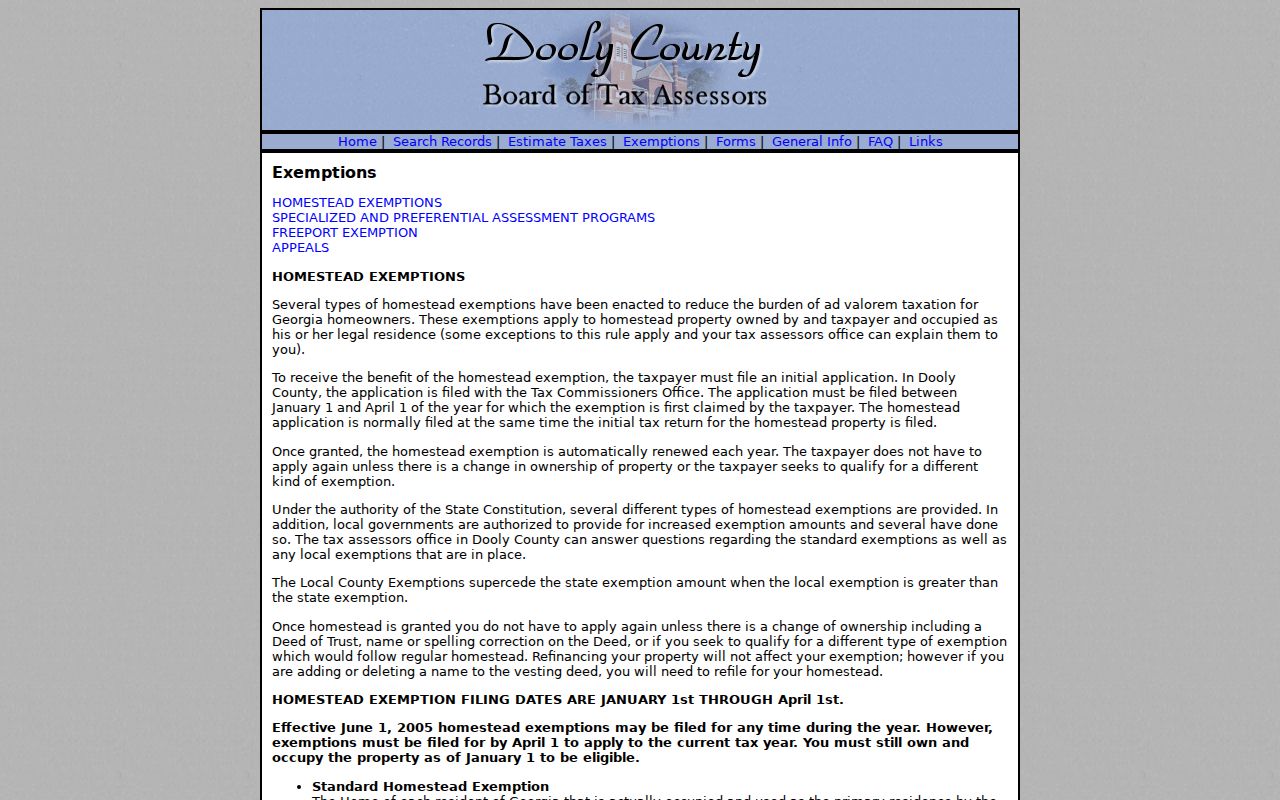
Exemptions and appeals belong to the assessor-side record path. The Tax Commissioner's payment ledger stays separate from that workflow entirely.
| Search key | Best input | If it fails |
|---|---|---|
| Owner | Last name or entity name | Try spacing, initials, trustee, estate, or company variants |
| Location address | House number and road name | Try Highway/Hwy and Road/Rd forms |
| Parcel number | Exact map-block-parcel string | Search each component or the parent parcel |
| Legal information | Land lot, subdivision, lot, or book/page clue | Confirm the deed or plat with the Clerk |
Rural tracts often lack a clear street number. In those cases the parcel key, road, land lot, or owner name works better. Municipal records may carry a U or V map prefix. For a split like 74C-53 and proposed 74C-53A, check under both keys, since planning files and assessment systems can update at different times.
Trace a Dooly County Tax Bill
Start with the assessment record. But finish with the Tax Commissioner. The Government Window start page is the county's named payment route. If the portal search stalls, that does not mean the account is missing. Call 229-268-4212 and ask for the existing bill and ledger by parcel and tax year.
- Find the exact parcel key and assessment year in qPublic or the ArcGIS extract. Save the legal-description text as a cross-check.
- Use Government Window when accessible. Otherwise ask the Tax Commissioner for the bill, payments, balance, penalties, and receipt for that tax year.
- Compare exemption codes with the assessor record. Ask which exemption actually applied rather than inferring it from a short field name.
- If delinquency appears, ask whether the file shows an unpaid bill, execution, published notice, completed sale, redemption, or recorded tax-sale deed.
- Assessed value
- The value carried for taxation after Georgia's assessment framework is applied.
- Millage or levy
- The tax rate applied by the relevant taxing authorities for the stated year.
- Homestead exemption
- Qualifying relief tied to ownership and occupancy rules as of January 1.
- Tax execution
- A collection record for unpaid tax; it is not the same as a completed tax sale.
Dooly Homestead Filing Dates
The Dooly exemptions page sets the general homestead filing window. It runs from January 1 through April 1 each year. Ownership and occupancy on January 1 are what count. After the county grants an exemption, it usually renews on its own. That continues until the owner sells the home or circumstances change. Seniors, veterans, surviving spouses, farmers, and landowners seeking conservation-use or Freeport treatment face separate rules. Each group has its own proof requirements.
Conservation-use land calls for extra care. A covenant can follow the land itself. So a tax field on the roll is only the first clue. Draw no conclusion about future obligations yet. Check the recorded covenant, breach, release, or transfer documents with the Clerk. File homestead paperwork with the Tax Commissioner. Take appraisal or classification questions to the assessor.
Note: Ask the office to confirm current forms and eligibility rather than treating a portal code as an approval.
Dooly's 2025 Millage Snapshot
A Dooly public notice reported a tentative 2025 millage rate of 17.45, an increase of 0.445 mills and an estimated 2.62 percent property-tax increase, with hearings held in September 2025. Those figures are a dated policy snapshot. They do not state a parcel's current balance or establish a 2026 rate.
The year label matters in every Dooly County property tax search. Save the notice, digest year, exemption state, bill, and receipt as separate records. A rate change can affect the bill even when the assessed value holds still. A changed assessment can affect the bill even before a payment record exists.
Dooly Delinquency Evidence
Dooly County publishes no searchable tax-sale roster online. That leaves a paper trail instead. Start with the Tax Commissioner, who holds delinquency files and sale-process records. The Clerk of Superior Court comes next. There you can search executions, judicial in rem filings, court orders, releases, and any recorded tax-sale deed. Finish at the Vienna News-Observer, the county legal organ, which prints the dated notice.
County minutes from 2010 confirm judicial in rem tax-foreclosure authority under O.C.G.A. § 48-4-76. Authority alone does not prove a given parcel finished the process. A notice, an execution, a petition, an order, an auction result, a redemption record, and a deed are all separate stages. Record each date and document type as you go.
Challenge a Dooly County Assessment
Dooly County lets an owner appeal within 45 days of the notice of change. The accepted grounds are taxability, value, or uniformity. Disliking the bill amount is not a ground. Routes vary by case. They can include the Board of Equalization, a hearing option, Superior Court review, or binding arbitration. The notice itself is the place to begin, since its date controls the whole window.
Strong evidence wins appeals. Bring the property record card, photographs, and measurements. Include comparable-property data tied to the same valuation date. A deed or survey can correct parcel facts. A plain list of errors keeps the case tight. When an ArcGIS abbreviation confuses you, ask for the CAMA field dictionary and value history. Keep proof of filing and every response.
Watch the notice date. A Dooly assessment appeal must be filed within the 45-day window stated in county guidance. A value appeal is not a tax-bill appeal.
Request Dooly Tax Records Offline
Georgia's Open Records Act, O.C.G.A. §§ 50-18-70 et seq., gives you a route when online tools fall short. Put the request in writing. Name the office, the parcel, the tax year, and the specific record. Ask the assessor for the card, value history, exemption codes, parcel map, field dictionary, and the data as-of date. The Tax Commissioner holds the bill, ledger, payment history, delinquency status, execution, sale notice, redemption record, and current sale list. Request any of those records by name.
The Attorney General's guidance sets the pace. An agency generally responds within three business days. Otherwise it explains its timing and estimated cost. The first 15 minutes of search and retrieval are free. Qualified labor may be charged after that. Paper copies may run up to 25 cents per page. Narrow requests save everyone time. Ask for electronic delivery and redaction of exempt details rather than wholesale withholding.