
Build a Backward Timeline of Dooly County Owners
Start with the most recent recorded acquisition and give every confirmed transfer its own row. Assessor value history is not an owner list. The GSCCCA index, clerk deed books, plats, probate records, and archival finding aids each cover a different slice. Together they fill out the ownership story. Check Dooly's exact online start dates before treating any gap as real.
| Source | Years It Covers | Where Held | What It Shows |
|---|---|---|---|
| GSCCCA deed index | All Georgia counties since at least 1999; exact Dooly dates unverified | Online and Superior Court Clerk | Party role, instrument, recording reference, and image route |
| Clerk deed books | Earlier local runs as surviving | 104 Second Street, Vienna | Recorded text, legal descriptions, and cross-references |
| Historic plats | Varies by recorded collection | Clerk, GSCCCA, Archives | Subdivision, lot, easement, and survey trail |
| Maps and local history | Selected dates, including Vienna 1924 | Digital Library, Archives, library | Old address and place context, not title |
Use GSCCCA when a modern name or a known book/page reference is in hand. When the online trail stops, turn to the clerk and the Archives, using maps only to translate place clues before heading back to the deeds.
Walk the Dooly County Deed Chain in Reverse
Search the newest owner as grantee in the GSCCCA Real Estate Index. Read the image for the prior grantor. Then search that grantor as an earlier grantee in a previous deed. At every step, compare land lot, district, subdivision, acreage, and recorded references. Matching names alone prove nothing.
- Locate the newest acquisition instrument and record its date, type, parties, and book/page.
- Copy the grantor and legal description from the image, including referenced plats.
- Find that grantor's earlier acquisition as grantee and verify the same land.
- Repeat until online coverage ends, then continue with the clerk's books or identified microfilm.
- Grantor and grantee
- The conveying and receiving parties named in an instrument.
- Chain of title
- The linked sequence of transfers for the same land.
- Reverse index
- A party-based route that helps connect each prior acquisition.
- Quit claim versus warranty
- Different deed forms whose warranties differ; neither label alone proves a clean chain.
Continue Dooly County Ownership Research Past the Web
GSCCCA reports deed-index data for all Georgia counties since at least January 1, 1999, and older data is added over time. Broad system dates beginning in 1990 appear on the site. Those dates do not confirm Dooly's county-specific start. Check the good-from and good-through link. Then ask the Clerk about the book you need. The Georgia Archives county card helps identify filmed or surviving runs.
Online coverage has a limit. The statewide baseline is at least 1999, not a verified Dooly start date. Earlier former owners may require deed books or microfilm.
Record Each Dooly Transfer as Evidence, Not Assumption
A good timeline separates what a source proves from what it only suggests. Keeping an index entry, a deed image, and a map clue in separate rows prevents them from collapsing into one unsupported claim.
| Transfer date | Grantor to grantee | Deed type | Book/page |
|---|---|---|---|
| From the recorded image | Copy both parties as indexed and as written | Use the clerk's instrument label | Preserve the exact reference |
| Prior linked date | Match the prior owner as grantee | Note estate, tax, sheriff, or quit claim form | Record every cited plat or earlier deed |
The table is a research log. A sample row is not a claim that a transfer occurred, so add each row only after the legal descriptions match.
Probate Can Explain a Break Among Previous Dooly Owners
A death alone changes nothing on the deed or the assessor card. Dooly Probate Court files can hold administration petitions, wills, and year's support awards. They can also hold inventories, guardianship papers, and orders. Each paper can name an heir. Search the decedent and estate representative in the deed index. Then look for an executor's deed, a deed from the estate, survivorship language, or a court order tied to the parcel. The Probate Court is at 104 South Second Street in Vienna, phone 229-268-4217. Legal-organ notices can reveal an estate number or representative. The complete court file and any recorded deed still carry the useful detail. An assessor mailing address is not proof of occupancy.
Old Dooly Addresses Need Map and Plat Translation
An old address is a clue, not an identity. The 1924 Vienna Sanborn map can relate an old downtown block or structure to present-day streets. It is a fire-insurance map, not a deed plat. Pair the historic address with current parcel geometry, then return to the legal description and the deed books. For annexed Vienna land, an ordinance, survey, plat, county-to-city deed, and minutes may each document a different step. Dooly's modern ArcGIS data still carries landlot, landdist, and landgmd fields from the county's land-lot history. It also separates Map, Block, Parcel, and SubParcel. Those fields bridge rural land without street numbers.
Plats Preserve Dooly Subdivision Origins
The GSCCCA plat form searches by name, district, land lot, Sec/GMD, date, and county. Local leads include Unadilla Heights, Ryals & Speight, Golden Pond, Cloverdale Estates #2, Kennedy SD, Drayton Woods, and Rolling Hills. Try spelling and spacing variants. Then inspect the plat image closely. Lot numbers, easements, dedications, and monuments hold the detail. Even when an address changed, a subdivision name can reconnect an older deed to a current parcel, but the deed chain still must link each grantor to the next grantee. It cannot name every owner alone.
Foreclosure and Tax-Sale Trails Require Separate Checks
A newspaper notice, a security deed, a court file, a sale result, a redemption record, and a deed under power are separate pieces of evidence. The Vienna News-Observer is the legal organ GSCCCA identifies. A 2025 notice cited a 2020 security deed at Deed Book 625, page 249. The notice alone does not prove the transfer finished. Dooly minutes from 2010 discussed judicial in rem tax-foreclosure authority under O.C.G.A. §48-4-76. That process needs its own records. Find the petition, the order, and the sale record. Never treat the public notice as the ownership-change date.
Note: Research ownership history for house history and lawful property diligence; never use public records to stalk, target, or harm a person.
Entity and Trust Names Complicate Dooly's Prior-Owner Chain
Dooly County parcels are not always held by individuals. A deed may instead name a company, a church, a public body, a trust, or an estate. Search the indexed spelling exactly. Then try reasonable variants in punctuation and spacing. For a Georgia company, the Secretary of State's eCorp search returns the entity name, control number, type, status, registered agent, and filing links. That corporate record identifies the entity. It cannot prove the company held the Dooly parcel. Only the deed trail proves ownership. Trustees can change while the trust stays the grantee, and an estate often bridges a death and a later conveyance, so search the fiduciary's name and the estate or trust phrase in both party roles.
When a public parcel display names a church or county board, treat that as the assessor's label and still check the recorded grantee in the deed records. Mailing addresses remain correspondence fields, never proof that any person physically occupied the land.
Dooly Legal Descriptions Keep the Same Land in View
Street names mislead. Ownership research in Dooly County often stalls when a searcher follows only an address. Older property records describe land by acreage, land lot, land district, subdivision lot, block, road references, and recorded book and page. The parcel layer shows abbreviated phrases like “H/L PT 29 30 BLK 8 BORUM ST 127-297” and “230.5 AC LL 79 82 3RD LD 175-132 PB 8/112.” Copy the source text exactly. Expand an abbreviation only in a separate note. Never alter a land-lot or recording number, and compare acreage cautiously because surveys, splits, and combinations change it.
A modern parcel key can differ. Bridge it with the old book/page and plat. A proposed subparcel such as 74C-53A calls for searches of the parent parcel, the application, the final decision, and any later recorded plat.
Document Gaps in Dooly Ownership History Honestly
A missing result is not a missing deed. The name may vary, the online dates may be incomplete, a book may sit unindexed, images may sit behind a login, an estate transfer may intervene, or the parcel description may have changed. Check the GSCCCA county good dates first. Rerun both party roles. Search by book/page, test the subdivision and plat fields, and ask the Clerk about the physical or filmed volume.
The Georgia Archives county card can flag surviving runs and courthouse-history notes. It is only a finding aid. Confirm any cited roll or book in the Archives catalog or with staff. Keep a gap log of what was searched, the date span, spelling, filters, results, and the next custodian. A logged gap beats an assumed former owner.
Use the Dooly Book and Page Form for Prior Owners
The GSCCCA book/page search reaches earlier Dooly deed references.
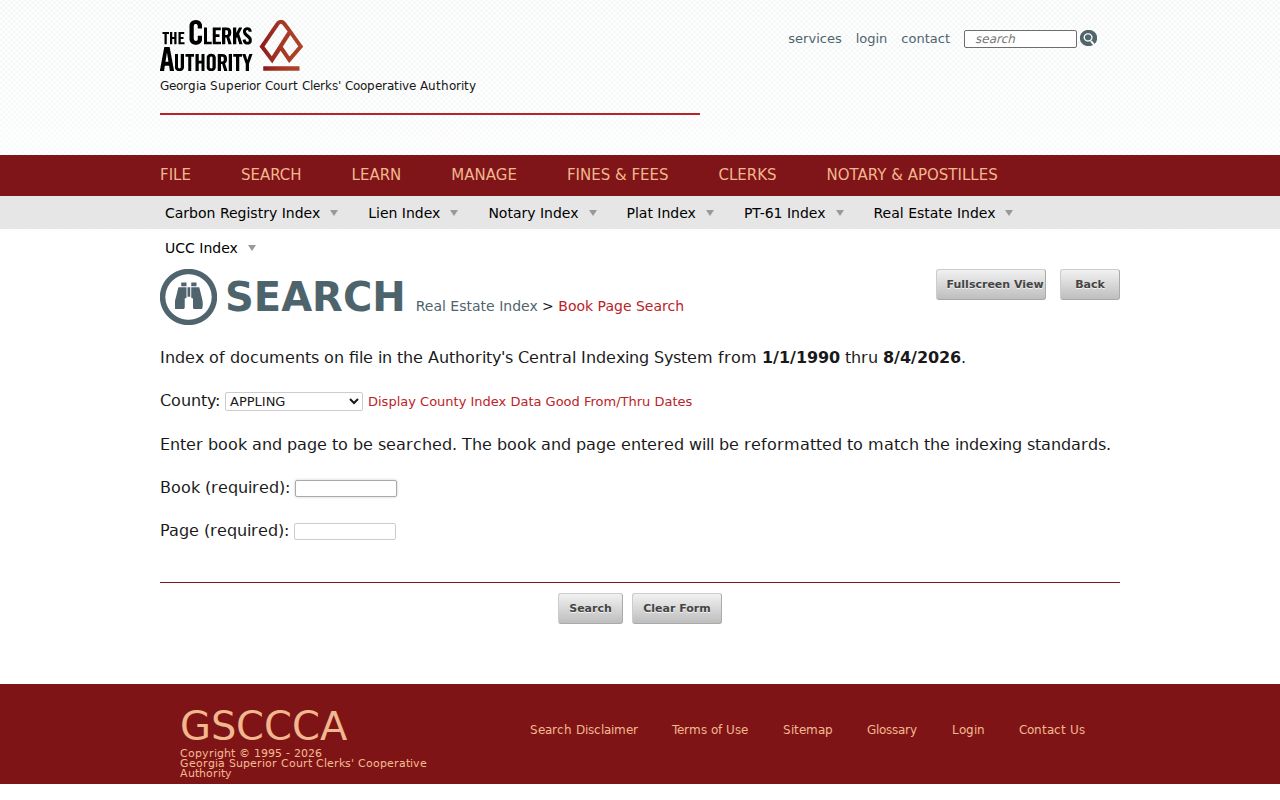
The form asks for county, book, and page. Exact references matter most when a prior owner's name changed or was indexed differently in the Dooly County property records.